

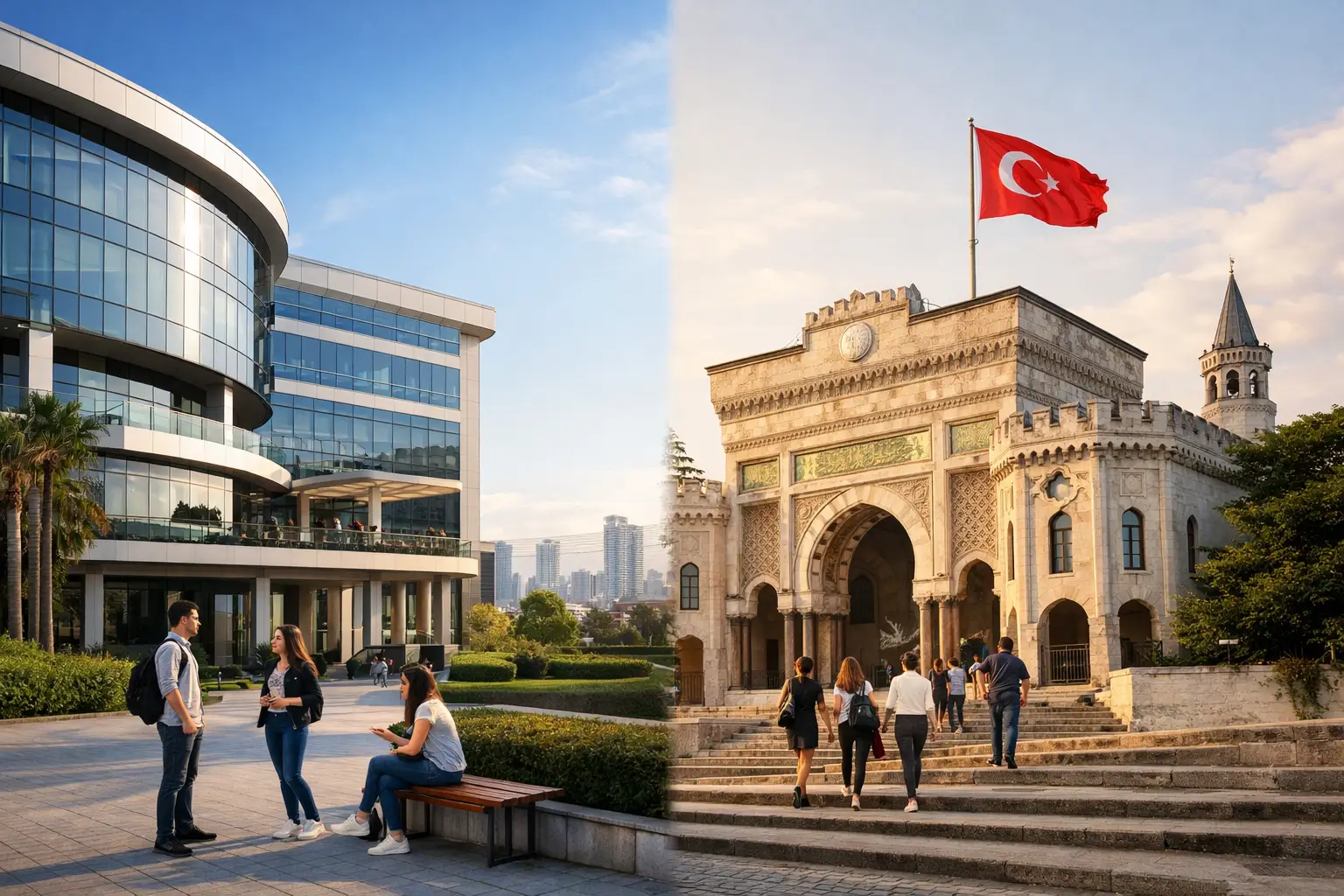
A student choosing between universities in Turkey is rarely asking a simple question. They are usually asking five at once: How fast can I get admitted? What will it cost? Will the degree be recognized? Can I study in English? And who will help me handle the paperwork? That is why the comparison of private vs public universities Turkey matters so much for international students and their families.
Turkey offers strong options on both sides, but they serve students differently. Public universities often attract applicants looking for lower tuition and a competitive academic environment. Private universities usually appeal to students who want faster admissions, more English-taught programs, and practical support during the registration process. The right choice depends less on prestige alone and more on your timeline, budget, academic profile, and language level.
Private vs public universities Turkey: the real difference
The biggest difference is not simply ownership. It is how each system works in practice for an international student.
Public universities in Turkey are state-funded. Because of that, tuition is usually lower, especially in Turkish-language programs. Many public institutions also carry strong academic reputations, particularly in medicine, engineering, law, and research-based fields. Admission, however, is often more competitive and less flexible. Deadlines can be strict, available seats for international students may be limited, and requirements can vary significantly from one university to another.
Private universities, also called foundation universities, are funded through tuition and institutional investment. Their tuition is higher, but they often offer more accessible admissions, wider English-language options, and stronger student support services. For many international students, that combination reduces time, confusion, and risk during the application process.
This is where families need to be careful. Lower tuition at a public university can look ideal on paper, but if the student cannot meet language requirements, misses a deadline, or struggles to secure a seat in the desired major, the lower price may not translate into a better outcome.
Tuition and total cost
If budget is the first filter, public universities usually win on annual tuition. In many cases, they are the more economical option, especially for students willing to study in Turkish. That said, total cost should never be measured by tuition alone.
Private universities often provide scholarship opportunities, discounts, and payment flexibility. Some also make the process easier for international students by reducing administrative delays and clarifying required documents early. For a family trying to avoid uncertainty, that has real value.
Living costs can be similar whether you choose a public or private university, especially if both are in Istanbul. Housing, transportation, food, and residence permit expenses do not disappear because tuition is lower. In fact, a lower-fee university in a city with high living expenses may still cost more overall than a private university in a better-fit location or with stronger support options.
So the practical question is not only, “Which is cheaper?” It is, “Which option gives me the best academic and administrative result within my budget?”
Admission requirements and speed of acceptance
For many international students, this is the section that decides everything.
Public universities often require a stronger academic file, and some may ask for entrance exam results or additional criteria depending on the program. Highly demanded majors such as medicine, dentistry, pharmacy, and engineering can be especially competitive. Even when a student is qualified, acceptance is not always quick.
Private universities generally offer a more flexible path. Many accept students based on high school grades, passport, and basic academic documents. Application windows may be longer, and the process is often more straightforward. This matters if you are applying late, switching plans, or trying to secure admission before visa and housing deadlines become urgent.
For students who want a faster route to enrollment, private universities usually provide a clearer advantage. That is one reason many international families prefer working with an experienced admissions partner rather than trying to compare dozens of institutions alone.
Language of instruction
Language can either expand your options or narrow them quickly.
Public universities in Turkey offer many strong programs, but a large share are taught in Turkish. There are English-taught options, especially at well-known institutions, but seats can be limited and competition can be intense. If your Turkish is not yet strong and your target public university does not offer your major in English, your path becomes more complicated.
Private universities tend to offer more programs in English, especially in fields popular with international students such as business, software engineering, international relations, psychology, architecture, and health sciences. For students from the Arab world and other international backgrounds, this can make the transition much smoother.
This does not mean English-taught is automatically better. A Turkish-language program at a respected public university may be the right choice for a student planning to build a long-term future in Turkey. But if your immediate goal is accessibility, international classroom environment, and easier academic adaptation, private universities often have the edge.
Academic quality and recognition
One of the most common misconceptions is that public automatically means better and private automatically means easier. Reality is more nuanced.
Turkey has excellent public universities with long histories, strong research output, and highly respected faculty. These institutions can offer outstanding academic value. At the same time, many private universities in Turkey have invested heavily in modern campuses, international partnerships, applied learning, and industry-connected programs. Some are especially strong in fields that benefit from practical training and global exposure.
The better question is whether the specific university is recognized, whether the program is well established, and whether it fits your career plans. A student interested in research and highly competitive public-sector pathways may prefer a public university. A student who wants flexible admission, modern facilities, internship exposure, and English-medium education may be better served by a strong private university.
Recognition should always be checked case by case, especially if you plan to return to your home country or continue with postgraduate study elsewhere.
Student life, support, and the international experience
This is where the gap often becomes more visible.
Private universities usually place more emphasis on student services for international applicants. That can include orientation, language support, academic advising, and easier communication with admissions offices. For a student arriving in Turkey for the first time, these details matter far more than brochures suggest.
Public universities can offer a rich campus experience and a more traditional academic atmosphere, but support systems may feel less personalized. Administrative processes can also be slower or less adapted to international students who need clear answers quickly.
If you are an independent student with strong Turkish skills and patience for formal procedures, a public university may still suit you well. But if you want a more guided transition from admission to arrival, private universities are often the more practical choice.
Which option is better for specific majors?
There is no universal winner. It depends on the field.
For medicine, dentistry, and pharmacy, both public and private universities can be attractive, but the route is different. Public universities may be more affordable and highly competitive. Private universities may be easier to access and more available to international students, though tuition is higher.
For engineering and computer-related majors, both sectors offer good opportunities. Public universities may carry strong academic depth, while private universities often emphasize labs, industry connections, and English instruction.
For business, media, design, and many social science fields, private universities frequently stand out because of language options, international networks, and practical learning environments.
This is why students should choose by major first, then compare institutions within that field rather than trying to pick a category in the abstract.
So, who should choose private and who should choose public?
A public university may be the better fit if you have a strong academic record, enough time to manage a competitive application, comfort with Turkish or a clear language plan, and a priority on lower tuition.
A private university may be the better fit if you want faster admission, more English-taught programs, a wider range of options in Istanbul, and stronger support through the registration and relocation process. For many international students, especially those balancing deadlines, visa planning, and family expectations, that combination is not a luxury. It is what makes studying in Turkey realistically possible.
At Directly Education, this is exactly where students benefit from proper guidance – not just information, but actual help comparing universities, securing admission, and moving from acceptance to arrival without getting lost in the process.
The smartest choice is not the one that sounds best in general conversation. It is the one that gets you into the right program, in the right language, at the right cost, with the least friction. If you make the decision that way, Turkey stops feeling complicated and starts looking like a very practical place to build your future.