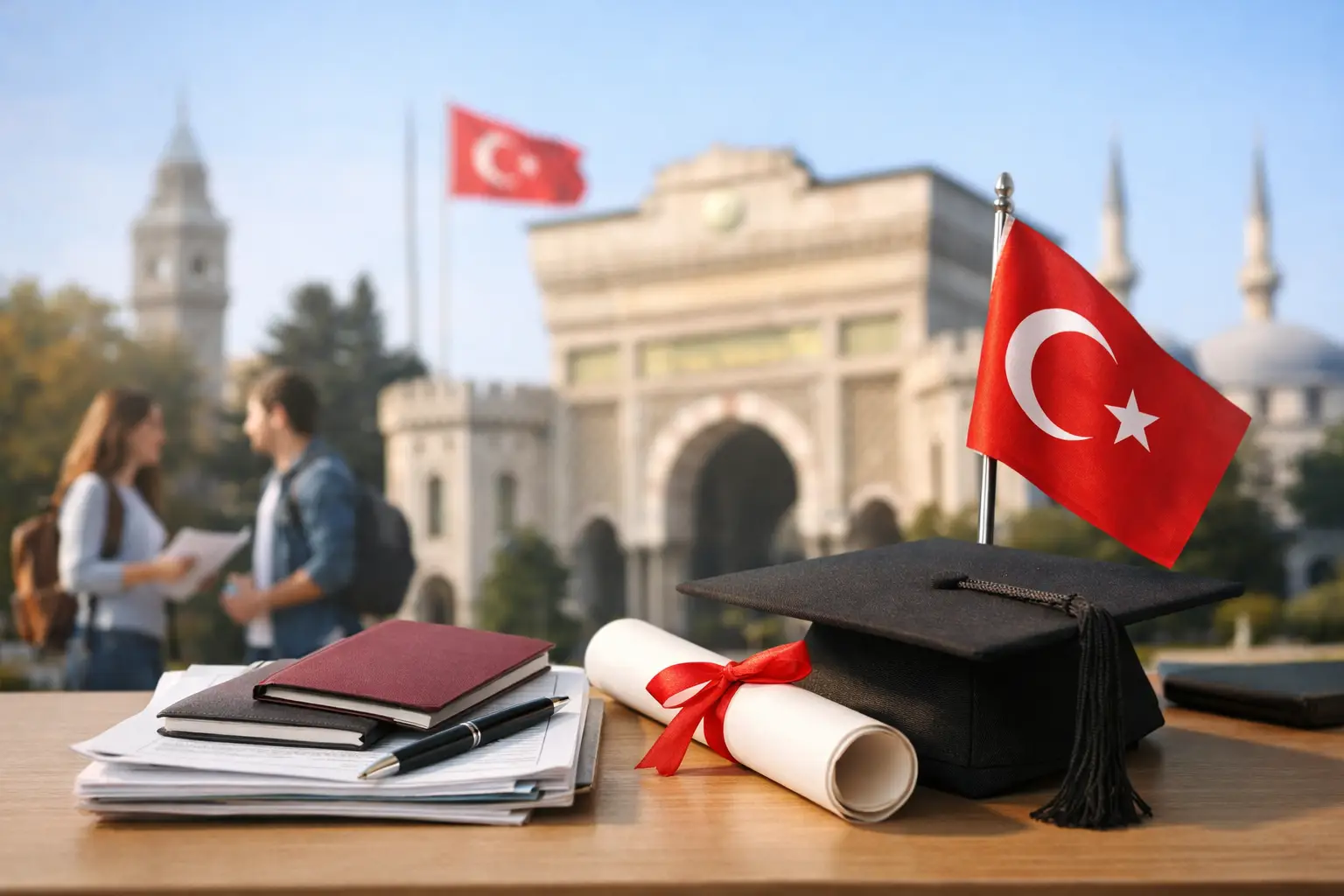


The fastest way to delay your admission in Turkey is not a low GPA or a competitive major. It is sending the wrong file, missing a translation, or uploading a document that the university cannot accept. If you are preparing your documents needed for Turkey university application, getting the paperwork right from the start can save days, and sometimes weeks, in the admission process.
For most private universities in Turkey, the document list is straightforward. The catch is that each university may ask for the same document in a slightly different format, and that is where many students lose time. Some accept an unofficial scan at the first stage and request originals later. Others want a translated version immediately. So the smart approach is not just collecting documents, but preparing them in a way that works across multiple universities.
Documents needed for Turkey university application
In most cases, you will need a passport copy, a recent personal photo, your high school diploma or expected graduation document, and your academic transcript. If you are applying for a master’s or PhD, the required academic papers expand to include your bachelor’s or master’s diploma, university transcript, and sometimes a CV, motivation letter, or recommendation letters.
That sounds simple, but the details matter. A passport copy should be clear, valid, and readable, with all information visible. A blurred scan can be rejected even if the document itself is valid. Your photo should usually have a plain background and be recent. Universities use it for student records, so an old cropped social photo often causes unnecessary back-and-forth.
Your diploma and transcript are the core of the file. If you have already graduated, you will usually submit the final diploma and final transcript. If you are still in your last year of high school, many universities allow an expected graduation certificate or a current enrollment letter instead of the diploma at the first stage. That flexibility is useful, but it depends on the institution and the timing of your application.
Academic documents: what universities actually check
Students often assume the diploma alone is enough. It is not. Turkish universities look at both qualification and academic performance. The diploma proves you completed the level required for admission. The transcript shows your grades, subjects, and in some cases whether you meet faculty-specific expectations.
For example, a student applying to engineering or computer science may be reviewed more carefully in math-related subjects. A student applying to medicine, dentistry, or pharmacy may face closer evaluation in biology and chemistry. In private universities, admission is usually more accessible than in many public institutions, but that does not mean academics are ignored.
If your transcript is in Arabic, French, or another language, a translated version may be needed. Some universities accept the original at the first evaluation stage and request a notarized Turkish or English translation later. Others want the translation before issuing the acceptance. This is one of those areas where it depends, and it is exactly why students benefit from having the file reviewed before submission.
Passport, ID, and photo requirements
A valid passport is the standard identity document for international students. If your passport is close to expiration, you can still apply in many cases, but it is better to renew it early if possible. A short-validity passport can create problems later with the student visa, residence permit, and enrollment completion.
Some students ask whether a national ID can replace the passport during application. For international admissions, the answer is usually no. Universities generally want the passport because it matches the official identity used for visa and residency procedures in Turkey.
Photos are often treated like a minor detail, but they should be prepared correctly. Use a clear passport-style image, avoid filters, and keep the file size reasonable. If the admissions team has to request a new photo, your application may simply move to the next review cycle.
Language documents: when they are required and when they are not
Many students worry that they cannot apply without TOEFL, IELTS, or a Turkish language certificate. In private universities, that is not always true. If the program is in English, some universities may accept you conditionally and let you take their own English proficiency exam or enter a preparatory year if needed. If the program is in Turkish, a TOMER certificate may be requested for direct entry, but students can often begin through a language preparation path.
This is where families often get confused. Admission and direct start in the major are not always the same thing. You may receive acceptance into the university, but still need to meet the language level before starting academic coursework. That is not a rejection. It is a normal pathway for many international students.
If you studied in English and have a school letter proving the language of instruction, some universities may consider it. Still, acceptance of that letter varies. A standardized test or the university’s own exam remains more reliable.
Additional documents for graduate applicants
If you are applying for a master’s degree, expect more than the basic undergraduate admission file. Universities commonly request a bachelor’s diploma, transcript, passport copy, personal photo, and sometimes a CV. Depending on the major, they may also ask for a statement of purpose, recommendation letters, or proof of language proficiency.
For PhD applications, the process is usually more selective. A research proposal, academic references, and a stronger proof of language level may be part of the file. Some departments also review whether your previous degree aligns closely with the field you want to pursue.
Graduate admissions in Turkey are not identical across universities. A business master’s program may process applications quickly with basic documents, while psychology, architecture, or health-related programs may ask for additional academic detail. The lesson is simple: prepare the standard documents first, then expect program-specific requests.
Translation, notarization, and equivalency
One of the biggest misconceptions is that every document must be notarized before you even apply. In reality, many private universities allow students to begin with scanned copies. Notarization and original documents often become necessary after acceptance, during final registration.
The same goes for translation. Not every university demands notarized translation at the first step. But if your documents are not in English or Turkish, having translations ready can speed things up. It is often the difference between receiving a same-week admission result and waiting while the file is returned for completion.
Equivalency is another area students hear about early and misunderstand. In Turkey, recognition or equivalency procedures may become relevant during final enrollment depending on your degree level, your school system, and the university’s internal registration rules. It is important, but it should not stop you from starting the application process. In most cases, admission can move forward while later registration requirements are clarified.
Common mistakes that slow down admission
The most frequent issue is sending incomplete files. A transcript without the diploma, a passport without the information page clearly visible, or a photo embedded inside a Word document instead of uploaded as an image are small mistakes that create real delays.
Another common problem is inconsistency. If your name is written one way in the passport and differently in the academic records, the university may ask for clarification. Even a small spelling difference can matter. The same applies to date formats, graduation dates, and missing school stamps or signatures on certificates.
Students also lose time by waiting to prepare documents one by one after choosing a university. A better approach is to build a complete digital admission file early. Keep clean scans in PDF format for academic documents and image format for photos and passport pages. Label each file clearly. That makes it easier to apply to several universities at once and compare offers without repeating the same work.
A smarter way to prepare your file
If your goal is fast admission, prepare for the broadest acceptable standard. Keep your passport valid, your photo recent, your diploma and transcript scanned clearly, and your translations ready if your documents are not in English or Turkish. If you are still studying, ask your school for a current enrollment or expected graduation letter before application season gets busy.
This is also where guided support makes a real difference. A team that works directly with Turkish private universities can often tell you which documents are enough for initial acceptance, which ones can wait until registration, and where a missing paper may become a problem later. That is how students move from confusion to confirmed admission without wasting energy on administrative guesswork.
At Directly Education, we see this every day: students are usually more ready than they think, but their paperwork is not organized in the right way yet. Once the file is prepared properly, the path becomes much clearer.
If you are planning to study in Turkey, treat your documents like the first stage of your admission, not just a formality. The right file does more than meet a requirement. It puts you in a stronger position to get accepted faster and start the next step with confidence.